
Mohammad Rizk, now PhD Researcher at Inria Rennes
I am currently a PhD researcher at Inria Rennes, France, under the supervision of Dr. Shadi Ibrahim. My research focuses on reliable and cost-efficient distributed storage systems, with an emphasis on improving data placement, retrieval, and recovery mechanisms in decentralized infrastructures. Through a collaboration between Inria and Hive, a decentralized cloud storage provider, I work on practical solutions that improve the reliability and efficiency of large-scale storage platforms.
My journey from Lebanon to France
Before moving to France, I completed a double Bachelor’s degree in Mathematics and Computer Science at the Lebanese University. This interdisciplinary background gave me strong analytical and problem-solving skills while building my interest in large-scale systems and computing infrastructures.
I joined the Master program in Computer Networks and IoT Systems at CNAM Paris. The program immediately attracted me because it combined networking, virtualization, cloud technologies, and distributed systems.
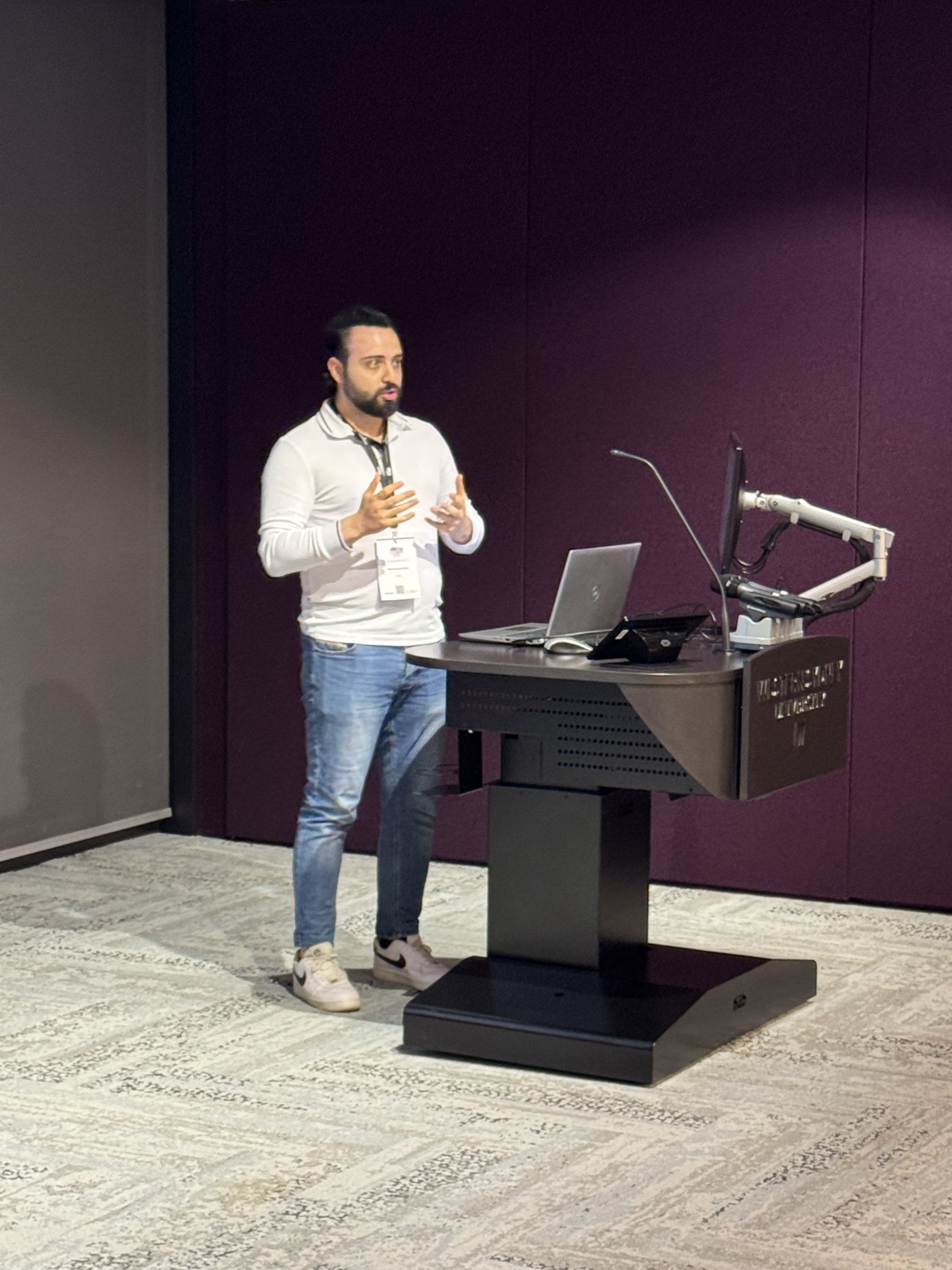
My journey through the Master’s Program at CNAM
The master’s program, directed by Professor Stefano Secci, provided me with a strong foundation in communication networks, cloud infrastructures, and distributed systems. Several courses were particularly valuable for my current research. The Network Evolution and Virtualization Architectures (NEVA) module, now updated as Network Operations, Virtualization and Automation (NOVA), provided me with a
strong understanding of modern network and cloud infrastructures, software-defined networking, and virtualization technologies. In addition, the Advanced Experimental Project allowed me to work on complex technical challenges in a hands on environment and develop a research oriented mindset.
After that, I did my internship at the Laboratoire Ville Mobilité Transport (LVMT) under the supervision of Dr. Daphne Tuncer. During this internship, I worked on data management solutions for smart buildings at the Energy4Climate (E4C) center, developing data models based on the Brick Schema framework. This experience introduced me to applied research and strengthened my interest in pursuing a research career.
The combination of advanced coursework, hands-on projects, and research experience ultimately motivated me to pursue a PhD at Inria Rennes and provided me with the background necessary to tackle challenging research problems in distributed systems.
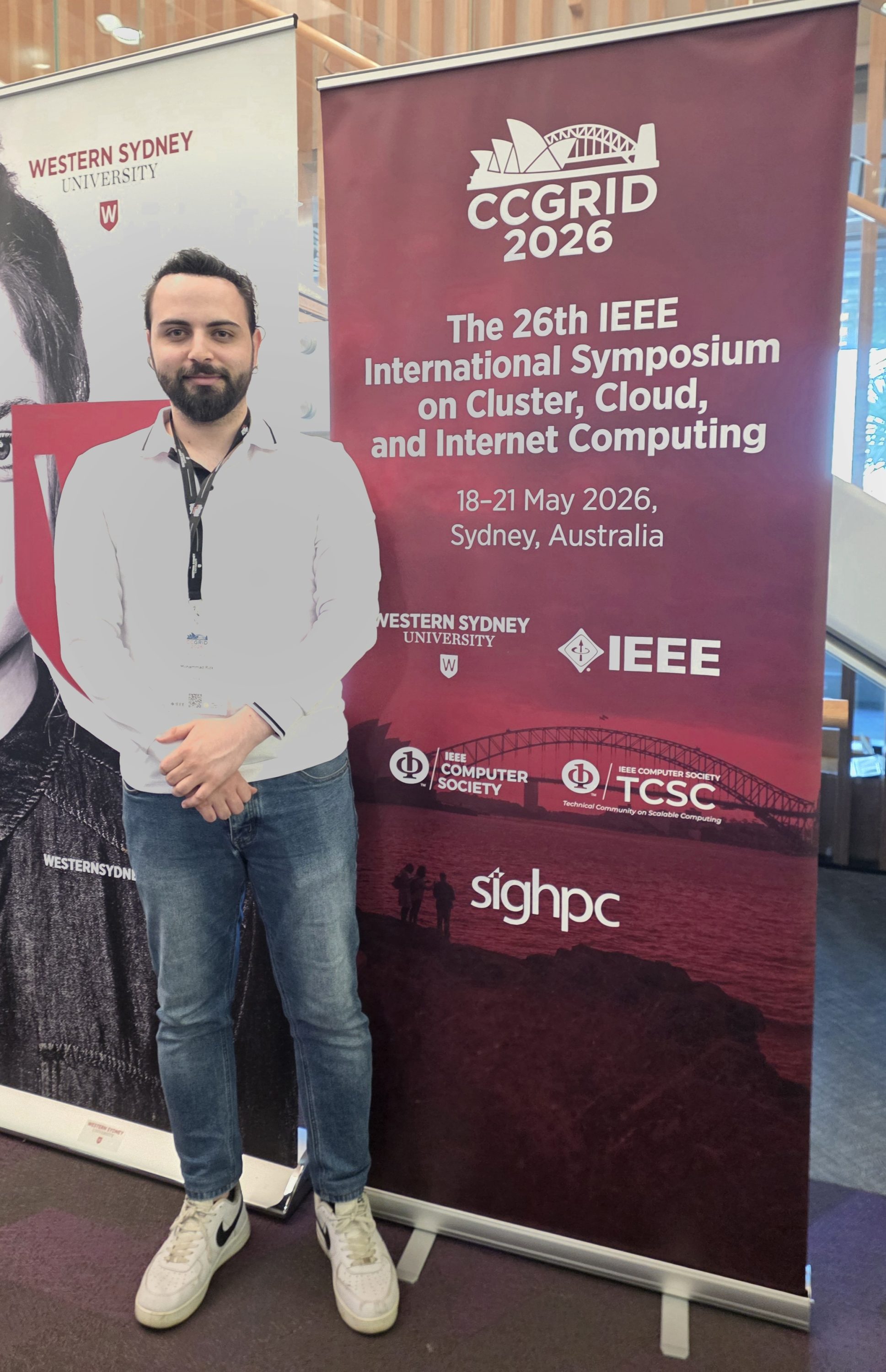
My current research at Inria
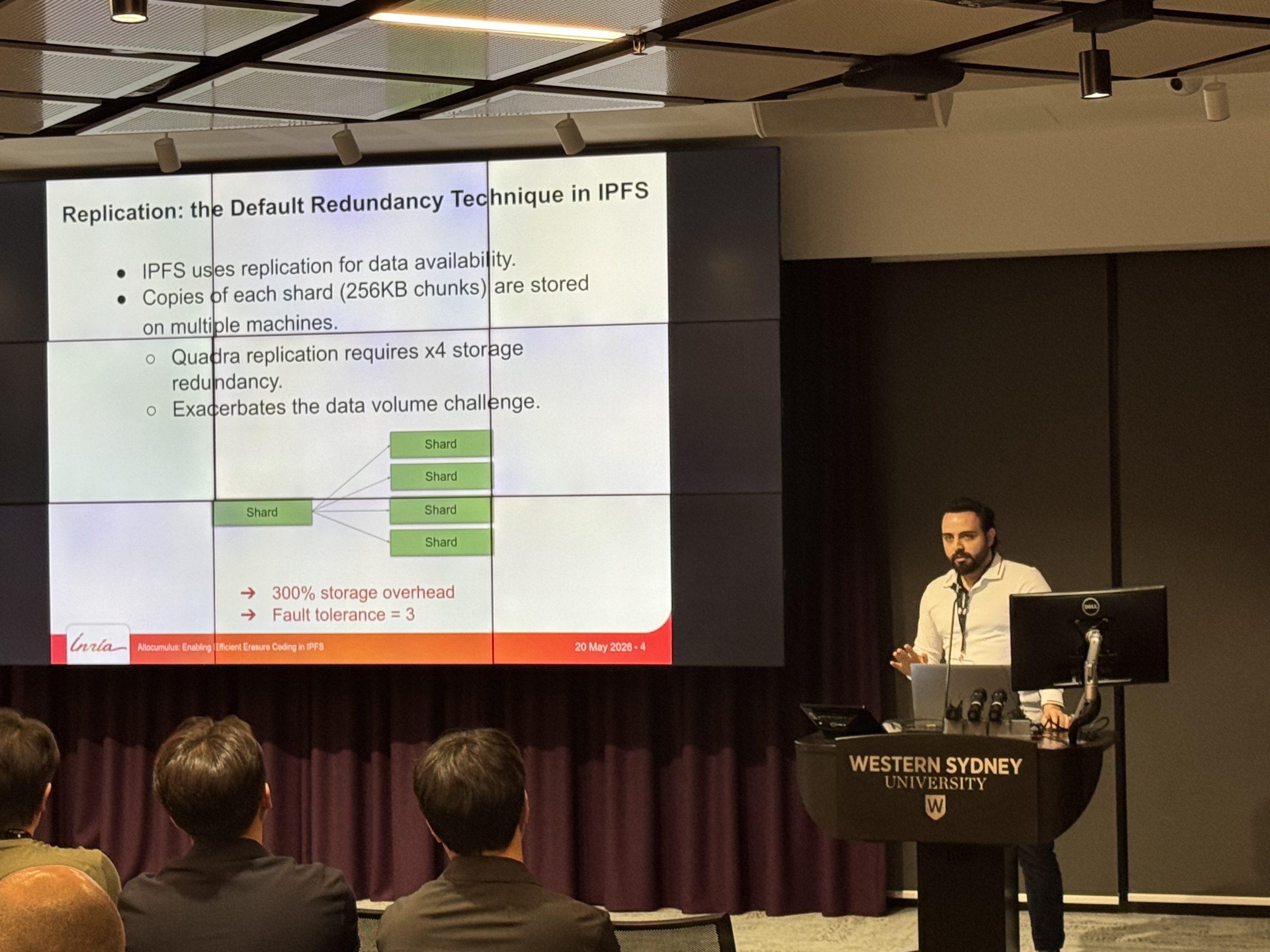
Today, my research focuses on improving the reliability, scalability, and efficiency of decentralized storage systems. As part of this work, we designed and developed Altocumulus, a distributed storage system built on top of IPFS that integrates erasure coding directly into the critical path of data access. The goal of Altocumulus is to provide a more storage-efficient alternative to traditional replication while maintaining
high levels of reliability and availability. Within this project, I developed a heterogeneity-aware retrieval strategy that improves data access efficiency by adapting retrieval decisions to the capabilities of participating nodes. In parallel, I investigate efficient repair mechanisms for storage systems, developing scheduling techniques that coordinate repair tasks across multiple nodes in order to accelerate recovery operations while reducing bandwidth consumption and resource utilization.
Our work on Altocumulus was presented at IEEE/ACM CCGrid 2026 in Sydney, Australia, and another work is under review. What I particularly appreciate about my PhD is the opportunity to work at the intersection of academia and industry through the collaboration between Inria and Hive, addressing real-world challenges while developing scientifically rigorous solutions.
Looking Back
Looking back, the Computer Networks and IoT Systems master’s program played a crucial role in shaping my academic journey. It provided me with the technical foundations, practical ex perience, and research perspective that enabled me to pursue advanced research in distributed systems and decentralized storage infrastructures.
The program served as a bridge between my background in mathematics and computer science and my current work on reliable and cost-efficient storage systems. I am grateful to the professors, researchers, and colleagues I met during my time at CNAM, whose support and guidance helped me take the next step
toward a research career.
For students interested in networking, cloud computing, distributed systems, and research, the CNIS master’s program offers an excellent environment to develop strong technical expertise and prepare for both academic and industrial careers.

Conference papers
- Mohammad Rizk, Shadi Ibrahim, Thomas Lambert. ALTOCUMULUS: Enabling Efficient Erasure Coding in IPFS. CCGrid 2026 - The 26th IEEE International Symposium on Cluster, Cloud, and Internet Computing, May 2026, Sydney, Australia. ⟨hal-05577974⟩
Poster communications
- Mohammad Rizk, Shadi Ibrahim, Thomas Lambert. Quantifying the Performance of Erasure Codes in P2P Storage Systems. SSDBM 2024 - 36th International Conference on Scientific and Statistical Database Management, Jul 2024, Rennes, France. 2024. ⟨hal-04857465⟩
Powered by HAL